GEO vs AEO vs Traditional SEO: What Actually Changes for Your Business (Not Just the Terminology)

GEO vs AEO vs LLM SEO is the debate everyone in search marketing is having right now, but the real question isn't which acronym wins. It's what actually changes about your website, your content and your reporting once you take all three, plus traditional SEO, seriously. Traditional SEO ranks your pages in Google's blue links. AEO gets your content pulled as a direct answer in featured snippets and voice search. GEO gets you cited or summarized inside ChatGPT, Perplexity and Google AI Overviews. A fourth term, LLM SEO, overlaps heavily with GEO but focuses specifically on visibility inside the LLM tools people go to directly, like a ChatGPT conversation, rather than search-adjacent AI features.
Here's what most explanations of this get wrong: they treat it as a definitions exercise, a straight GEO vs AEO breakdown with no business context. Your business doesn't need a glossary. It needs to know which ranking factors matter now, which content structure actually earns a citation, and how to measure whether any of this is working. That's what this guide covers.
Key takeaways
- Traditional SEO, AEO, GEO and LLM SEO all reward the same foundation (clarity, authority, structure) but weigh it differently, and treating them as one strategy rather than four separate campaigns is the only approach that scales.
- AEO is about being extracted as a direct answer. GEO is about being synthesized into an AI-generated response. LLM SEO is about being recognized as a trustworthy source inside a specific AI tool's knowledge. Traditional SEO is about ranking a page.
- The businesses currently winning aren't the ones that picked one term and optimized for it. They're the ones that restructured their existing content once, in a way that happens to serve all four surfaces at the same time.
- Ranking on Google still helps GEO and AEO, but it doesn't guarantee either one, and the gap between the two is measurable and growing.
- Where you should start depends on your business type more than on any universal best practice.
The Four Terms, Defined Simply
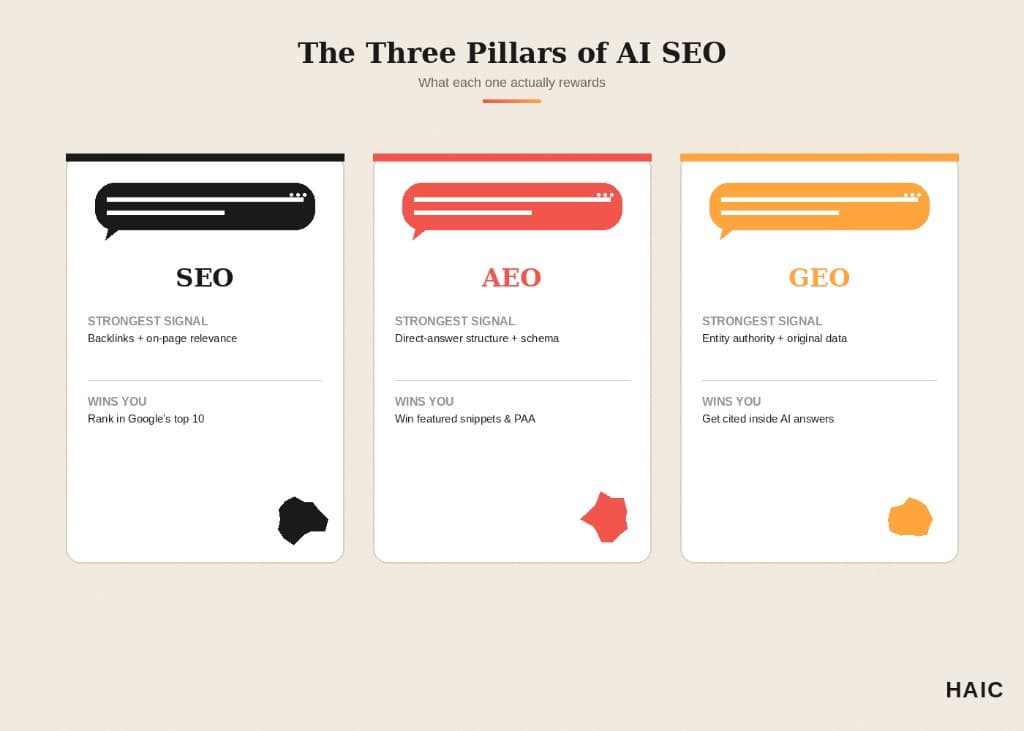
| Term | What it optimizes for | Where it shows up |
|---|---|---|
| Traditional SEO | Ranking a page in Google's organic results | The standard blue-link results page |
| AEO (Answer Engine Optimization) | Being extracted as the direct, quotable answer | Featured snippets, People Also Ask, voice assistants |
| GEO (Generative Engine Optimization) | Being cited or summarized inside an AI-generated response | Google AI Overviews, AI Mode, Bing Copilot |
| LLM SEO | Being recognized as a trustworthy source inside a specific AI tool | A ChatGPT, Perplexity or Gemini conversation directly |
The overlap between these four is real, and it's the most important thing to understand before you do anything else. Reduce it to a simple geo vs seo or aeo vs seo comparison and you'll miss that a page written with a direct-answer opening, clear headings and genuine expertise tends to perform across all four surfaces at once. Generative engine optimization vs SEO isn't really a competition; it's an extension. You are not running four separate campaigns. You are building one content foundation that happens to get read differently by four different systems.
Where Each One Actually Shows Up (And Why That Matters)
This distinction matters because each surface has a different job in your buyer's journey, and confusing them leads to optimizing the wrong thing. Framed simply as AI search vs traditional search, the split comes down to this: traditional search still expects you to click and evaluate, while AI search hands the buyer a synthesized answer and calls it done.
Traditional SEO still owns the moment when someone is actively comparing options and wants to click through and evaluate a site themselves. AEO owns the fast, single-fact question, the kind asked on a phone while walking, where a full page visit was never going to happen anyway. GEO and LLM SEO own the moment your buyer has stopped browsing entirely and started asking an assistant to just tell them the answer, or recommend a vendor outright. The line between LLM SEO vs GEO gets blurry here, since both are ultimately trying to earn the same kind of trust from the same underlying models, just through slightly different surfaces.
That last one is the surface most businesses are currently losing without realizing it.
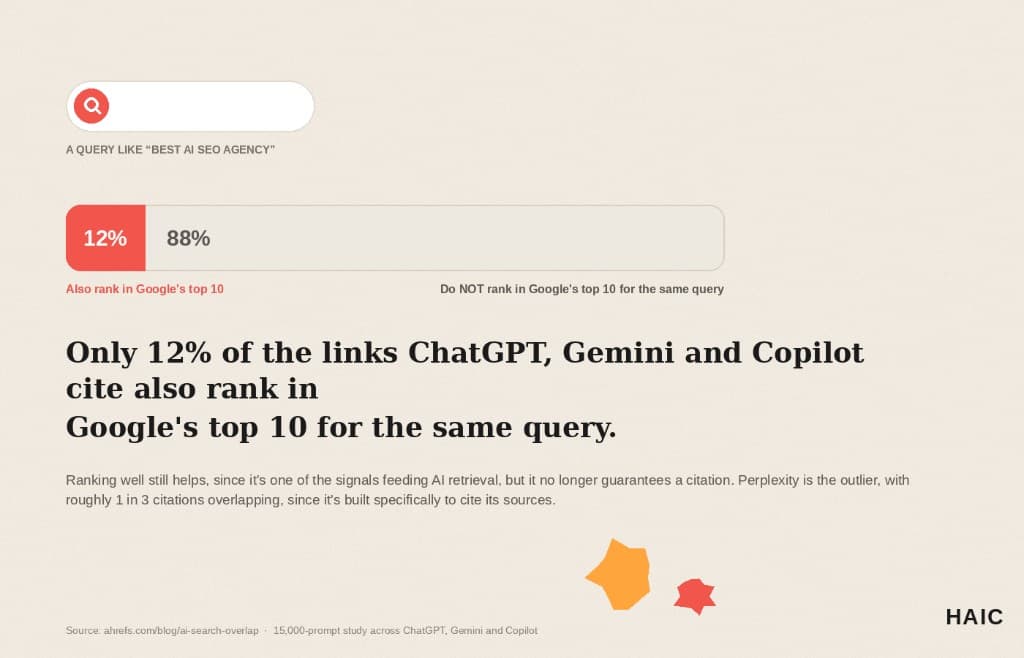
Ahrefs' research found that on average, only 12% of the links ChatGPT, Gemini and Copilot cite also rank in Google's top 10 for the same query. Ranking well is not the same as being cited well, and the two are diverging, not converging.
What Actually Changes for Your Business
This is the part that matters more than the terminology. Here's what genuinely shifts as you move from traditional SEO toward AEO, GEO and LLM SEO.
The content unit gets smaller. Traditional SEO optimizes a whole page to compete for a keyword. AEO, GEO and LLM SEO all reward individual passages, usually 40 to 150 words, that can answer one specific sub-question cleanly on their own. A page can win on Google while losing on AI citations simply because none of its individual sections stand alone.
The success metric splits in two. You now need to track organic rank and organic clicks the way you always have, alongside citation frequency and share of AI answers, which most reporting dashboards still don't include by default. If your monthly report only shows Google positions, you are only seeing half the picture.
The timeframe compresses. Ahrefs found that the share of AI Overview citations pulled from Google's top 10 fell from roughly 76% in mid-2025 to about 38% in early 2026, a shift that happened in under a year. Traditional rankings move over months. AI citations can shift within days as models re-retrieve and re-rank content.
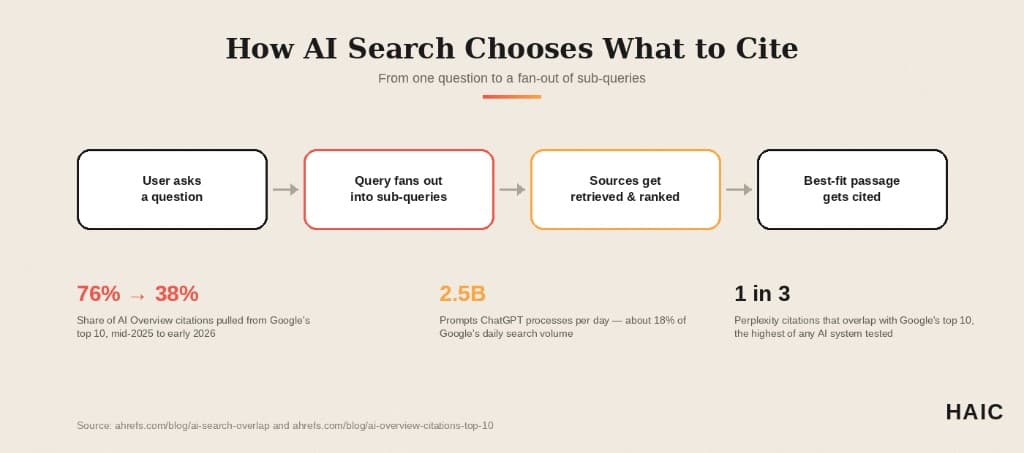
The authority signal changes shape. Traditional SEO leans on backlinks pointing at a specific page. GEO and LLM SEO lean much more heavily on entity authority: the same business description, the same service names and the same facts appearing consistently across many independent sources, not just strong links to one URL.
Original data starts to outrank generic advice. A specific number from your own work is far more likely to be lifted into an AI-generated answer than a well-optimized but generic paragraph saying the same thing everyone else says.
Do You Need All Four?
Yes, but not all at once, and not in the same order for every business.
For a B2B service business (consultancies, law firms, financial services, SaaS), GEO and LLM SEO should come first. Your buyers increasingly research vendors by asking an AI tool to compare options before they ever visit a website, so being the name that comes up in that comparison matters more than winning a keyword nobody at the decision stage is typing anymore. A firm that shows up when someone asks ChatGPT to "compare the top three options" is already past the awareness stage with that buyer before a single visit is logged in analytics.
For a local, premium service business (clinics, studios, boutique retail), AEO and traditional SEO still carry more weight day to day, since "near me" and map-pack style searches remain heavily click-through and location-driven. GEO still matters here, particularly for higher-consideration purchases like choosing a specific clinic or studio over a nearby competitor, but it's the second priority, not the first. Get your Google Business Profile, reviews and local schema solid before spending heavily on GEO-specific content.
Either way, the sequencing that works in practice is: fix your entity consistency first, restructure your best existing pages for direct-answer extraction second, and only then invest in new content built from scratch. Trying to build new GEO-optimized content on top of an inconsistent entity foundation wastes the effort, since the models doing the citing are weighing your overall entity trust more than any single new page.
A Simple Framework to Prioritize
- Search your own category questions across Google, ChatGPT and Perplexity, and note where you appear and where you don't. This single exercise tells you more about your actual priority order than any generic framework can.
- Fix entity consistency before writing anything new. The same business description and service names, everywhere your business is mentioned.
- Restructure, don't just publish. Add direct-answer openings and clear question-based headings to the content you already have before creating new pages.
- Track citations and rankings side by side, monthly, as one report rather than two separate check-ins.
The Terminology Debate Nobody Has Settled
If you've noticed that different sources use different third and fourth terms here, that's not you missing something. It's a genuinely unresolved industry argument. In a public debate hosted by Graphite Growth, the founders of Graphite, AthenaHQ and Surfer each made the case for a different name (AEO, GEO and AI SEO respectively), and when they asked ChatGPT, Perplexity and Gemini to weigh in, the three models each picked a different term too. Perplexity even noted that "AI SEO" as a phrase already carries far more search volume than "GEO" or "AEO" individually.
None of that changes what you should actually do. It's a useful reminder not to get stuck picking the perfect label before doing the work the label describes.
Frequently Asked Questions
What's the difference between GEO and AEO?
GEO is about being cited or summarized inside an AI-generated answer, like a Google AI Overview or a ChatGPT response. AEO is about being extracted as the direct, standalone answer for a featured snippet, voice search result or People Also Ask box. They overlap heavily but target different surfaces.
Is LLM SEO the same as GEO?
They're closely related. GEO generally covers search-adjacent AI features like Google's AI Overviews and Bing Copilot. LLM SEO focuses specifically on the AI tools people go to directly, such as a ChatGPT or Claude conversation, where the user has bypassed a search engine entirely.
Does traditional SEO still matter if I'm focused on AI search?
Yes. Ranking well remains one of the signals that feeds AI citation systems, particularly Google's own AI Overviews. It's the foundation the other three build on, not something you can skip.
Which should a small business prioritize first, GEO, AEO or traditional SEO?
It depends on how your buyers actually search. A B2B service business whose buyers research vendors conversationally should prioritize GEO and LLM SEO. A local business relying on "near me" searches should keep AEO and traditional SEO as the priority, with GEO as the next investment.
How is AI search visibility actually measured?
Track citation frequency (how often you're mentioned across ChatGPT, Perplexity and AI Overviews for your core category questions) alongside your normal organic rankings and clicks. Most standard SEO dashboards don't include this by default, so it usually needs to be tracked manually or with a dedicated tool.
Can a page rank well on Google and still be invisible in AI search?
Yes, and it happens often. Ranking and AI citation are correlated but increasingly decoupled. A page can hold position one on Google and never get pulled into an AI Overview if it isn't structured for extraction.
Ready to See Where You Stand?
This is one piece of the bigger picture. For the full framework, read our complete guide to AI SEO in 2026, or book a free AI visibility audit through our contact page to see how your business currently appears across ChatGPT, Perplexity and Google AI Overviews.
About the Author

Elton Coutinho
CEO, HAIC
Elton Coutinho is Founder and CEO of HAIC, the search agency helping brands rank on Google and get cited across ChatGPT, Perplexity, Gemini and Google AI Overviews.
Connect with Elton on LinkedInOriginally published Aug 8, 2026