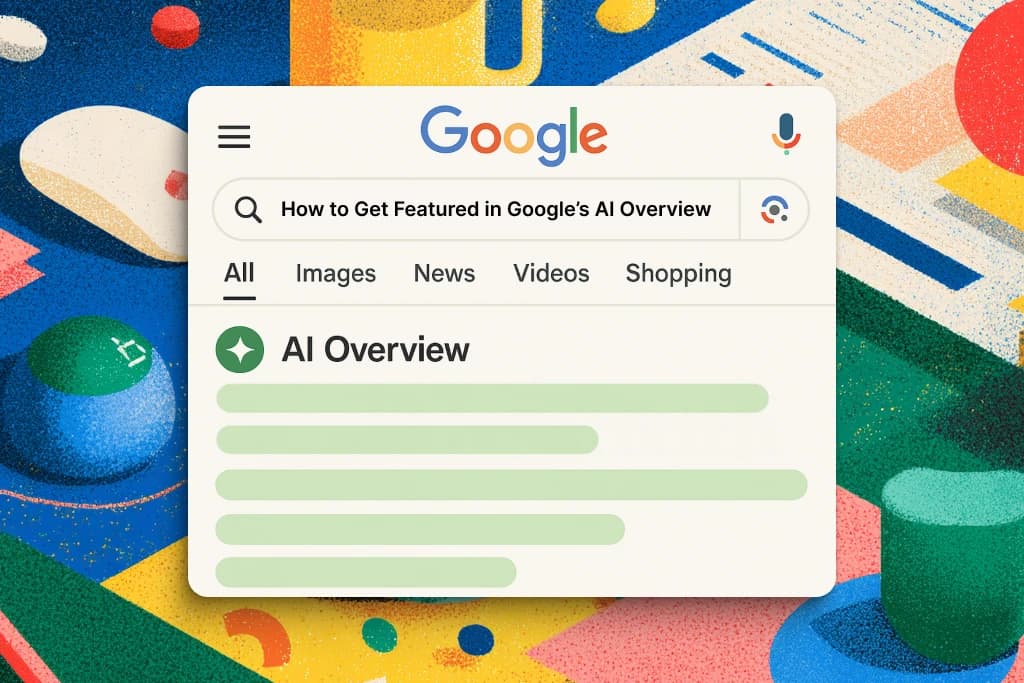
Why your business isn't appearing in AI Search Results & how to fix it.

Introduction
If your business website ranks on Google but does not appear in ChatGPT, Gemini, Perplexity, or Google AI Overviews, your SEO strategy is outdated. The rise of the AI-driven search landscape means that content must be optimized not just for traditional search engines, but also for AI-powered environments. This shift requires a new approach to your content strategy—one focused on making information easily discoverable and extractable by AI systems.
AI search systems do not rank websites the same way traditional search engines do. Understanding user behavior within AI search platforms is crucial: users now interact with search in more conversational and complex ways, which changes how visibility is achieved. Instead of showing pages, large language models (LLMs) extract trusted information from sources they understand, trust, and can structurally interpret.
What is AI Search Optimization?
AI search optimization is the evolution of search engine optimization, specifically tailored for AI systems and their unique requirements. Generative engine optimization focuses on making your content discoverable and interpretable by AI engines and AI crawlers—ensuring it is structured for effective indexing and citation in AI-generated answers.
How does AI search work?
AI search tools use:
- Vector search
- Semantic entity understanding
- Knowledge graph relationships
- Structured content extraction
- Trust and authority signals
Some AI search platforms use "AI mode" to break down complex queries into multiple subqueries, delivering more comprehensive and relevant results. Semantic relationships, internal linking, and related concepts help AI systems connect and interpret content more effectively by clarifying how topics are related and improving overall content structure. Instead of ranking pages, they select reliable knowledge sources.
Why is your website missing?
Because AI systems cannot always:
- Understand your expertise
- Connect your brand to industry entities
- Trust your content as a knowledge source
- Recognize high content quality
- Interpret vague language, which reduces clarity and relevance
Traditional SEO alone no longer guarantees visibility.
The Power of AI-Powered Search
AI search systems have restructured information retrieval in ways most businesses underestimate. While legacy search engines ranked pages through link signals and keyword matching, modern AI platforms—including Google's generative features—extract answers directly from content through entity recognition and semantic understanding. Users now expect immediate, contextually relevant responses that match their specific search intent, not just lists of potentially useful pages.
Companies that align their content architecture for AI extraction position themselves for sustained organic visibility across both conventional search engines and emerging AI platforms. These systems prioritize content that demonstrates clear topical authority, maintains structured data signals, and addresses user intent through natural language patterns—when done right, that visibility flows to qualified pipeline generation.
Strategic positioning requires abandoning surface-level optimization in favor of systematic content authority: comprehensive topical coverage that serves AI extraction behavior, information structured for semantic clarity, and monitoring entity signals that influence AI citation likelihood.
Key Reasons Your Business Isn't Visible in AI Results
1. Your website has no entity authority
AI systems rely on the Google Knowledge Graph and entity relationships. If your company, founders, services, and expertise are not clearly defined entities, AI tools cannot associate your site with topics.
Fix: Build entity presence using structured About pages, author profiles, industry mentions, Schema.org data, consistent brand information, and digital PR to secure high-authority brand mentions and citations.
2. Weak semantic SEO architecture
Many websites publish disconnected blogs with no topical structure. AI systems prefer sites that show deep expertise clusters.
Example — bad structure: random marketing articles with no relationship to each other.
Example — good structure: AI SEO guides, AI ranking factors, GEO strategies, AI visibility case studies, and technical AI optimization tutorials—clustered by theme.
Fix: Build topical clusters instead of isolated content. Ensure each heading or section focuses on one idea to improve readability and AI comprehension.
3. No structured data implementation
AI systems use structured data to understand context. Schema markup helps search engines and AI systems interpret your content by converting it into machine-readable structure.
Without Schema.org markup, AI systems struggle to interpret services, organization information, authors, FAQs, and processes.
Fix: Implement Article, Organization, Service, FAQ, and Author schema as appropriate.
4. Weak E-E-A-T signals
AI systems prioritize trusted sources. Low E-E-A-T (Experience, Expertise, Authoritativeness, Trustworthiness) often means no author credibility, no industry proof, no expert positioning, and no external validation.
Fix: Show real expertise, include case studies, highlight industry experience, add expert commentary, ensure clear authorship, and optimize author bios with verifiable credentials. Strong E-E-A-T boosts AI visibility and long-term credibility with readers.
5. Content written for search engines, not answers
AI systems extract content that answers questions directly. If your content is over-optimized, keyword-stuffed, vague, or fluffy, it gets ignored.
Fix: Write structured, answer-driven content. Lead with direct, concise answers—one or two sentences that clearly address the question—to improve your chances of being cited in AI summaries and featured snippets.
Understanding AI Answers
AI answers represent a shift in how search systems deliver intelligence: beyond link aggregation toward synthesizing structured knowledge into direct, contextually precise responses. Modern AI systems perform semantic analysis across large repositories to extract actionable insights. For consistent visibility, your content must demonstrate semantic precision and architectural sophistication—hierarchical structures, direct response frameworks, and data organization that signal authority rather than superficial tactics from older SEO playbooks.
AI Search Ranking Factors in 2026
AI visibility depends on:
- Entity recognition
- Topical authority clusters
- Structured content formatting
- E-E-A-T trust signals
- Knowledge graph association
- Semantic content depth
- Brand mentions and citations
- Technical crawl clarity
- Content extraction friendliness
- Domain trust history
Features like AI summaries, Google's AI Overviews, and Bing AI influence which content is surfaced. SEO rankings alone are no longer enough.
Framework: How Businesses Can Fix AI Visibility
Step 1: Entity optimization
Clarify who you are, what you do, and why you are credible—across your website and external sources.
Step 2: Topic authority building
Own topics; don't only chase keywords. Create clusters around services and industries.
Step 3: Structured content formatting
Use clear headings, direct answers, lists, tables, and summary blocks. Structuring content with lists and tables helps AI engines extract information efficiently, including when they analyze multimedia and multimodal sources. Use logical HTML hierarchy to maximize extractability.
Step 4: Schema and technical alignment
Add structured data and improve crawlability. Improve page speed so AI crawlers can access and index your pages reliably.
Step 5: Brand and trust building
Mentions, partnerships, publications, and citations strengthen AI trust. Citation share matters: well-optimized sites are more likely to receive direct citations in AI-generated summaries, which boosts authority and visibility.
Creating AI Overviews
AI overviews are a strategic battleground for visibility. Optimization for AI extraction requires systematic content architecture: topical authority via structured data, entity clarity, and semantic depth that models can parse efficiently—hierarchical organization, authoritative linking, and unique insights that position your brand as a definitive voice.
When Should You Hire an AI SEO Agency?
Consider experts if traffic is stagnant despite SEO investment, competitors appear in AI answers, you lack in-house expertise, or leads from organic search are declining.
ROI of AI Search Optimization
Businesses winning AI visibility often see higher qualified inbound leads, reduced ad dependency, stronger authority positioning, and long-term discovery channels. AI search is becoming a primary discovery layer; ignoring it risks future traffic loss.
What Most Businesses Miss (According to Experts)
Many companies assume rankings equal visibility. In reality, AI tools often cite lower-ranking sites that demonstrate clearer expertise and trust. Winning AI search is about knowledge authority, clear semantic structure, and extraction-friendly content—not rankings alone.
FAQs: AI Search Optimization
Why is my website not appearing in ChatGPT?
Because AI tools prioritize trusted entity sources with structured, authoritative content.
Does ranking on Google guarantee AI visibility?
No. AI tools select sources based on expertise and structure, not rankings alone.
What is LLM visibility?
Whether large language models use your content in generated answers.
How long does AI SEO take?
Usually three to six months, depending on authority and implementation quality.
Is AI SEO different from traditional SEO?
Yes—it focuses on knowledge authority, not just rankings.
Can small businesses appear in AI search?
Yes, if they demonstrate expertise and structured authority.
Conclusion
AI search is rapidly becoming a main gateway to information discovery. Businesses relying only on traditional SEO risk disappearing from customer journeys. Winning visibility requires entity authority, semantic SEO architecture, trust signals, and AI-friendly content structures.
To stay visible in AI results, your content must be both human-first and AI-friendly: helpful, credible, and structured so machines can interpret it easily. Businesses investing early will be best positioned for AI discovery.
If your business is not appearing in AI search, the solution isn't more keywords—it's smarter AI search optimization. Next step: conduct an AI visibility audit or consult an AI SEO specialist to build a long-term discovery strategy.
About the Author
HAIC Team
Visibility & Discovery
The HAIC team helps brands control how they are discovered, understood, and recommended across search engines and AI-driven assistants — from technical SEO to GEO and AEO.
Originally published Mar 23, 2026