How to Rank in Google AI Overviews: A Guide for Businesses
Introduction
Google Search has shifted. Businesses are no longer competing only for blue links—they are competing for AI-generated answers. High placement in AI Overviews can dramatically increase visibility and credibility.
To rank in Google AI Overviews, your content must become a trusted source that Google’s AI models extract, summarize, and cite. This requires more than traditional SEO: it demands AI Search Optimization (AEO/GEO). Getting featured can be a game-changer for traffic and brand trust.
In practical terms:
- Google’s AI pulls content from authoritative, well-structured sources
- Pages must demonstrate expertise, trust, and topical authority
- Content must be structured so models can extract clear answers
- Entities, semantic structure, and authority signals matter more than keyword density alone
AI Overview visibility is a key metric for online success. Overviews change how users engage with search—pushing standard organic listings down. Businesses that adapt gain disproportionate visibility; those relying on legacy tactics can lose organic traffic.
This guide explains how businesses can rank in Google AI Overviews, including how the search generative experience (SGE) shapes what gets surfaced and why AI systems are now central to ranking and discovery.
Search intent: What businesses want to solve
Primary intent is strategic and informational, with commercial decision-making mixed in. Leaders typically want to know:
- How AI Overviews select sources
- Which ranking factors matter
- How to optimize content and sites
- Whether they need an AI SEO strategy or agency
- Expected ROI and implementation steps
- How to map real user questions to content that answers pain points
Overviews are common for informational queries. Strong strategies address those queries with structured, user-centric content. Tools like People Also Ask and AnswerThePublic can surface questions worth targeting.
What are Google AI Overviews?
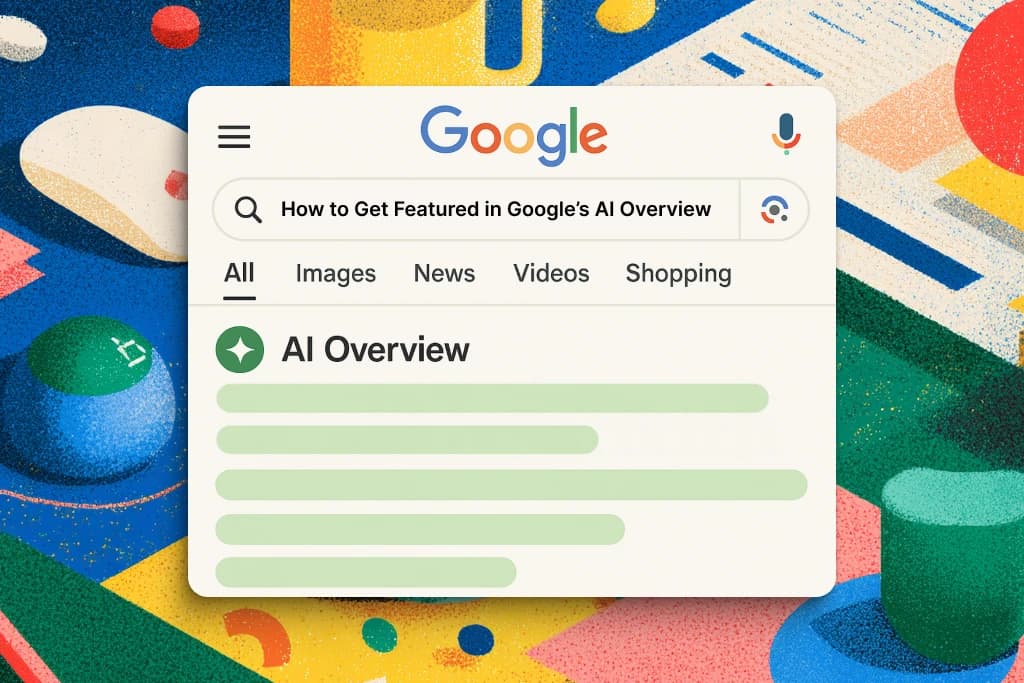
Google AI Overviews are AI summaries shown near the top of search results—reducing traditional blue-link dominance. They are powered by Google’s generative search experience using models similar to Gemini. Overviews synthesize information from multiple sources and usually include concise responses to queries.
How AI Overviews work (simplified)
- User enters a query
- Google identifies intent
- AI synthesizes answers using trusted web sources
- Citations favor authoritative content that directly answers the query—such as government, education, and leading industry publishers
- Users click through to cited sources
Google may use query fan-out to expand the primary query into related sub-questions for more comprehensive answers. Winning means becoming one of the cited sources. Direct answers at the top of sections (often 40–50 words) help address who, what, why, and how.
Understanding the AI Overviews rollout
AI Overviews represent a restructuring of search architecture—not just an interface tweak. They control primary visibility real estate through entity recognition and topical clustering. Blue links have become secondary infrastructure for many queries.
Legacy SEO—chasing keywords and links alone—often optimizes for a system that no longer determines primary visibility. Success requires understanding extraction behavior: how authority is evaluated, how structured data is parsed, and how topical expertise is weighted when summaries are built. Search Console reveals patterns, but strategy—not reactive tweaks—creates durable advantage.
Depth, expertise, and structured knowledge matter more than checklist SEO.
Why traditional SEO alone is no longer enough
Traditional SEO often focused on keywords, backlinks, technical performance, and ranking individual pages. Covering broader topics and related sub-queries—building topical authority—is now essential for Overviews. Models prioritize clarity, trust, and depth over repetition.
Generative AI influences Overviews and impacts traffic and awareness. Optimizing for SERP features—including Overviews, featured snippets, and PAA—is part of an effective strategy.
Core ranking factors for Google AI Overviews
Technical SEO, schema, and readable short paragraphs help AI and users alike. FAQ and HowTo schema can structure content for rich results and AI comprehension. Core Web Vitals and engagement matter for rankings and visibility.
1. Topical authority and content depth
AI prefers comprehensive coverage. Winning sites build topic clusters, strong internal linking, consistent expertise signals, and category ownership—often via pillar pages linked to satellite articles.
2. E-E-A-T signals
Experience, Expertise, Authority, and Trust—through authorship, case studies, insights, transparent business presence, client stories, and genuinely helpful answers.
3. Extractable content structure
Winning pages often include definition blocks, bullet lists, frameworks, tables, and clear answer paragraphs. Paragraphs that directly answer questions are frequently cited.
4. Entity and knowledge graph strength
Reinforce brand, industry, technology, and service entities. Mentions across trusted sites and authoritative pages strengthen entity signals.
5. Structured data and technical clarity
Use Article, FAQ, Organization, Service, HowTo, and related schema as appropriate. Structured clarity improves machine interpretation. Ensure important content and schema are available in raw HTML when possible—AI crawlers may struggle with some JS-only experiences.
6. Engagement and behavioral signals
Satisfaction, usefulness, interaction, and repeat visits matter. Clickbait loses visibility over time.
Optimizing for semantic relevance
Shift from keyword stuffing to semantic authority: clear relationships between concepts, strong information architecture, and entity-based optimization. Schema is a strategic necessity for AI interpretation. Audit content for semantic gaps that keyword tools miss—comprehensive coverage improves Overview citation odds and traditional performance.
Leveraging generative engine optimization (GEO)
GEO focuses on how systems like Gemini extract and synthesize information—not only on classic ranking mechanics. Execution requires authoritative architecture, clear hierarchies, semantic precision, and extractable patterns. Address user intent while building citation-worthy content. Analyze extraction patterns across generative surfaces to strengthen entity recognition over time.
Step-by-step framework to rank in AI Overviews
Step 1: Define core authority topics
Pick categories where your brand should dominate—for example an AI SEO agency might own AI search, visibility, and AI content optimization. Align content with intent and structured relevance.
Step 2: Build topic clusters
Create interconnected articles and use internal linking to pass authority.
Step 3: Structure content for AI extraction
Include definitions, steps, frameworks, FAQs, and comparison tables. Short paragraphs improve extraction.
Step 4: Reinforce brand and author authority
Publish commentary, case studies, original insights, and analysis; reference authoritative sources where appropriate.
Step 5: Optimize technical and schema signals
Prioritize fast performance, clean architecture, proper schema, and crawlable structure.
Implementation strategy
Many companies lack entity strategy, weak architecture, traditional-only thinking, or AI visibility monitoring—external AI SEO expertise is often required.
Measuring performance
Use Search Console for impressions, CTR, and positions across standard and AI-influenced results. Analytics connects traffic to conversions. Specialized AI visibility tools can show which queries surface your content in Overviews. Tie metrics to revenue and authority—not vanity numbers alone.
When should businesses hire an AI SEO agency?
Consider an agency when organic traffic declines, Overviews reduce clicks, competitors appear in AI answers, or content underperforms despite effort.
ROI of ranking in AI Overviews
Benefits include higher trust visibility, qualified leads, brand authority, reduced ad dependence, and sustainable traffic advantage. Early adopters often see disproportionate returns.
FAQs: Ranking in Google AI Overviews
How do you rank in Overviews?
Create authoritative, well-structured content that models cite when generating summaries.
Do backlinks still matter?
Yes—authority and topical trust often matter more than raw link counts alone.
Can small businesses rank?
Yes, especially with niche topical authority.
How long does AI SEO take?
Often three to six months for measurable shifts.
Does schema guarantee ranking?
No—but it improves machine understanding.
Will AI replace SEO?
No—SEO evolves into AI search optimization.
How do I know if my site appears in Overviews?
Monitor queries, Search Console, and traffic patterns alongside AI visibility tooling.
Is AI SEO expensive?
It can require more upfront investment but offers long-term advantage when executed well.
Conclusion: SEO has entered the AI era
Google search is transitioning from ranking pages alone to ranking trusted sources. Businesses that build authority, structure content for extraction, and optimize for AI will dominate future visibility.
Next step: Audit AI search readiness and build an execution roadmap. HAIC helps businesses transition from traditional SEO to AI-driven search visibility.
About the Author
HAIC Team
Visibility & Discovery
The HAIC team helps brands control how they are discovered, understood, and recommended across search engines and AI-driven assistants — from technical SEO to GEO and AEO.
Originally published Mar 23, 2026